
By TLA Therapy · Clinically reviewed by Lindsay Rickel, LCSW · November 2026
You're rocking your baby at 2 a.m. and a thought flashes through your mind: What if I dropped her? Or you're giving a bath and picture the water closing over your baby's face. The thought horrifies you. You push it away, and then you lie awake wondering what kind of parent thinks that.
If this sounds familiar, you're not alone, and you're not a bad parent. Unwanted, upsetting thoughts about harmful things happening to your baby are one of the most common and least talked-about parts of new parenthood. Here's what they are, what's normal, and when it makes sense to get support.
What are postpartum intrusive thoughts?
Intrusive thoughts are sudden, unwanted thoughts or images that feel completely out of character. After a baby arrives, these thoughts can often center on the baby's safety. Common examples include:
Picturing your baby falling, drowning or being hurt
A flash of "what if I accidentally hurt the baby?" while near something sharp or dangerous
Fears that you'll do something harmful without meaning to
Worry that your baby will stop breathing while asleep
What if I miss something that’s wrong with my baby because I don’t know what to look for
Why they happen
A new baby puts your brain on high alert for danger. Add sleep loss, the sharp drop in estrogen and progesterone after birth, and the weight of being responsible for a tiny person, and your mind starts generating worst-case scenarios. These thoughts sometimes appear strongest in the first few weeks postpartum. They're also remarkably common: at least 70% of new moms report unwanted thoughts about their baby being harmed, according to a study in BMC Psychiatry (UPMC), and partners have them too.
What's common
The key sign that a thought is intrusive is that it upsets you. You don't want it, it feels foreign, and you'd never act on it. In fact, the distress that these thoughts cause is a sign of how much you care. Having a scary thought is not the same as wanting it to happen, and it does not make you a danger to your child.
When to reach out for help
Occasional scary thoughts that come and go are common. It's worth talking to a therapist if and when:
The thoughts are frequent, hard to shake or take up hours of your day
You avoid your baby or everyday tasks, like bathing them, changing them, or even using common household items like kitchen knives, to keep the thoughts away
You check on your baby over and over, or need constant reassurance that everyone is safe
You feel persistent sadness, anxiety, numbness or trouble bonding
You can't sleep even when your baby is sleeping
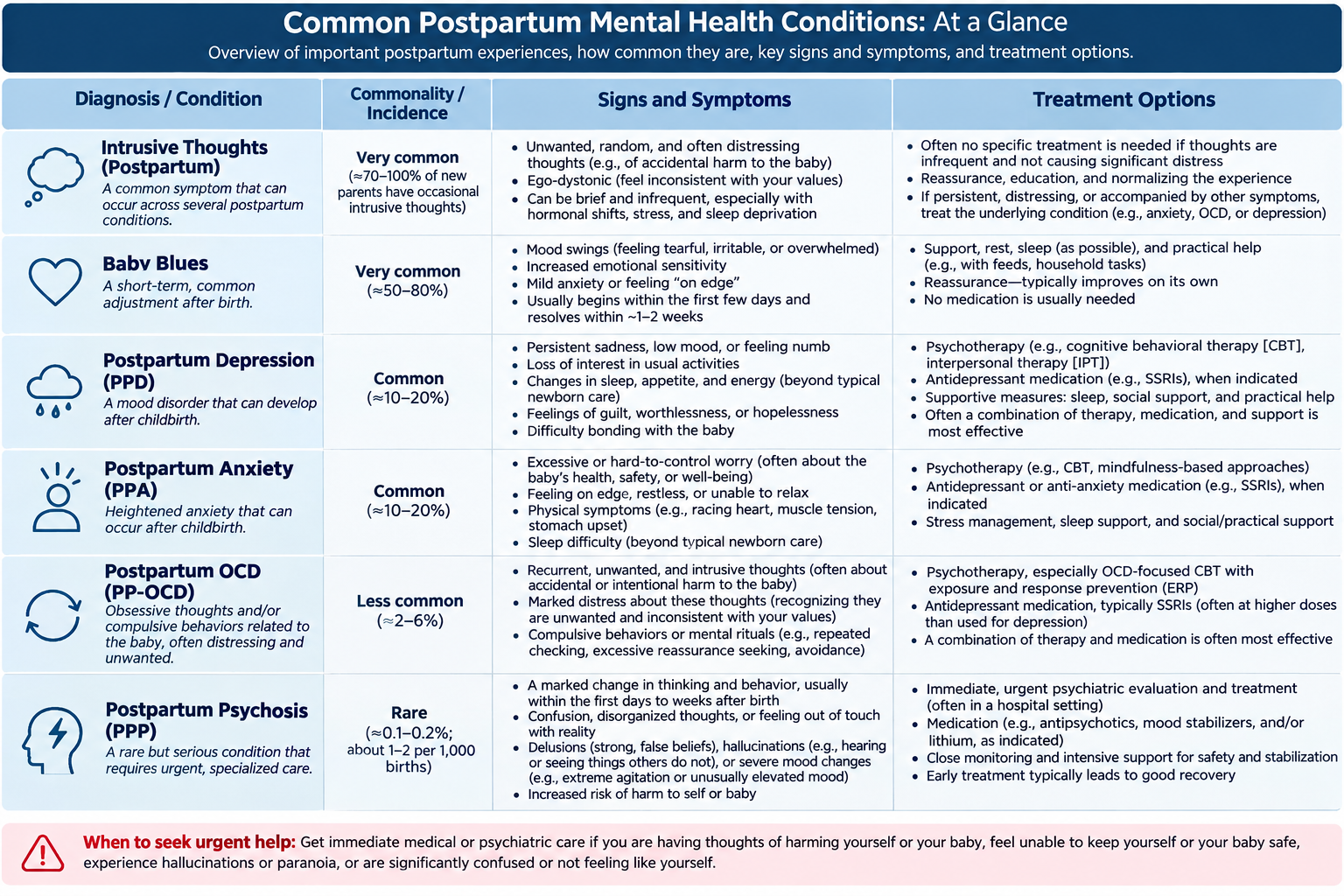
These can be signs of postpartum OCD, postpartum anxiety or postpartum depression. All three are common and treatable, and getting help early makes recovery easier.
When it's urgent
Postpartum psychosis is rare but serious. If you or someone you love is seeing or hearing things that aren't there, feels confused or out of touch with reality, or no longer feels distressed by thoughts of harm, call 911 or go to the nearest emergency room.
How therapy helps
The instinct with a scary thought is to fight it, avoid whatever triggers it or seek reassurance. Those moves bring short-term relief, but they teach your brain the thought is dangerous, so it comes back louder. Therapy helps you break that cycle.
Cognitive Behavioral Therapy (CBT) helps you understand the thoughts for what they are, mental noise from an overprotective brain, and respond to them differently.
Exposure and Response Prevention (ERP), the leading treatment for OCD, gently helps you stop avoiding and checking so the thoughts lose their power.
Dialectical Behavior Therapy (DBT) skills help you ride out intense emotions and the sleep-deprived overwhelm without spiraling.
Often the first step is simply saying the thought out loud. As Dr. Eynav Accortt, director of the Reproductive Psychology Program at Cedars-Sinai, puts it: "The more you have these thoughts and keep them to yourself, the bigger they get—like a balloon. But the moment you tell your mom, sister, partner or therapist, it puts a pin in them, deflates them and you feel better."
Perinatal support at TLA Therapy
TLA therapists have training and a special interest in perinatal mental health. We see new and expecting parents in person in West LA and the South Bay, or online anywhere in California, so you can get support from home, during nap time. We also coordinate with your OB, pediatrician or psychiatrist, including around medication while pregnant or breastfeeding.
Learn more about pregnancy and postpartum therapy or book a free consultation.
Frequently asked questions
Does having intrusive thoughts mean I'll hurt my baby?
No. Intrusive thoughts are unwanted and upsetting, which is the opposite of intent. Parents with these thoughts typically go out of their way to keep their baby safe, and research offers preliminary evidence that the thoughts themselves don't raise the risk of harm. Telling a doctor or therapist about them will not get your baby taken away.
Are intrusive thoughts a sign of postpartum depression?
Not always. They're common on their own, but they can show up alongside postpartum OCD, anxiety or depression. A therapist can help you sort out what's going on.
Do dads and partners get intrusive thoughts too?
Yes. Partners experience them as well, and they can struggle with anxiety and depression after a baby arrives. We support partners and couples too.
Is online therapy effective for postpartum anxiety and OCD?
Yes. Online therapy works well for postpartum anxiety, OCD and depression, and many new parents find it far easier to keep up with than getting to an office.
If you need support now
National Maternal Mental Health Hotline: call or text 1-833-TLC-MAMA (1-833-852-6262), free and confidential, 24/7
Postpartum Support International HelpLine: call or text 1-800-944-4773 (not a crisis line).
In a crisis: call or text 988, or call 911
This article is for general information and isn't a substitute for professional care.
Resources
Sources
Postpartum Intrusive Thoughts: Managing Mental Health in Early Motherhood, UPMC HealthBeat, Nov 2021
The Difference Between Postpartum Anxiety, OCD and Psychosis, Cedars-Sinai, May 2023
National Maternal Mental Health Hotline updated number, 1-833-TLC-MAMA, Maternal Mental Health Leadership Alliance
Sources for the chart:
Screening and diagnosis of mental health conditions during pregnancy and postpartum: ACOG clinical practice guideline no. 4. Obstetrics and Gynecology, 2023
Postpartum psychiatric disorders. Nature Reviews: Disease Primers, 2018
Postpartum depression-new screening recommendations and treatments. JAMA, 2023
Vital signs: postpartum depressive symptoms and provider discussions about perinatal depression-United States, 2018. MMWR: Morbidity and Mortality Weekly Report, 2020
Anxiety disorders during pregnancy and the postpartum period: a systematic review. The Journal of Clinical Psychiatry, 2006
Treatment and management of mental health conditions during pregnancy and postpartum: ACOG clinical practice guideline no. 5. Obstetrics and Gynecology, 2023
Postpartum anxiety: a state-of-the-art review. The Lancet: Psychiatry, 2025
Prevalence and risk factors for postpartum depression 2 months after a vaginal delivery: a prospective multicenter study. American Journal of Obstetrics and Gynecology, 2024
Prevalence, predictors, and functional impact of postpartum depression using the patient health questionnaire-9 (PHQ-9) among 830 women. BMC Pregnancy and Childbirth, 2026
Single session intervention for postpartum intrusive thoughts. ClinicalTrials.gov, 2026
Report: workshop on maternal mental health, February 11-12, 2024, cosponsored by the American College of Obstetricians and Gynecologists. Pregnancy, 2025
Perinatal obsessive-compulsive disorder: epidemiology, phenomenology, etiology, and treatment. Current Psychiatry Reports, 2022
Interventions to prevent perinatal depression: US Preventive Services Task Force recommendation statement. JAMA, 2019
The global prevalence of major depressive disorder during the peripartum period: a systematic review and meta-regression. The Lancet: Psychiatry, 2026
Concise review for physicians and other clinicians: postpartum depression. Mayo Clinic Proceedings, 2014
Decline in postpartum depression. JAMA, 2017
Heterogeneity of postpartum depression: a latent class analysis. The Lancet: Psychiatry, 2015
Detection of postnatal depression. Development of the 10-item Edinburgh postnatal depression scale. The British Journal of Psychiatry, 1987
Accuracy of brief screening tools for identifying postpartum depression among adolescent mothers. Pediatrics, 2014
JAMA welcomes the US Preventive Services Task Force. JAMA, 2016
Past psychiatric conditions as risk factors for postpartum depression: a nationwide cohort study. The Journal of Clinical Psychiatry, 2020
Anxiety disorders in postpartum women: a systematic review and meta-analysis. Journal of Affective Disorders, 2016
Prevalence of and risk factors for postpartum anxiety in a U.S. cohort with commercial insurance. Obstetrics and Gynecology, 2026
Risk of obsessive-compulsive disorder in pregnant and postpartum women: a meta-analysis. The Journal of Clinical Psychiatry, 2013
High prevalence and incidence of obsessive-compulsive disorder among women across pregnancy and the postpartum. The Journal of Clinical Psychiatry, 2021
Canadian Network for Mood and Anxiety Treatments (Canmat) and International College of Obsessive-Compulsive Spectrum Disorders (ICOCS) 2025 international guidelines for the management of patients with obsessive-compulsive disorder. Journal of Psychiatric Research, 2026
Diagnosis and treatment of postpartum obsessions and compulsions that involve infant harm. The American Journal of Psychiatry, 2012
Postpartum-onset obsessive-compulsive disorder: incidence, clinical features, and related factors. The Journal of Clinical Psychiatry, 2007
Postpartum psychosis during delivery hospitalizations and postpartum readmissions, 2016 – 2019. American Journal of Obstetrics & Gynecology MFM, 2023
Recognizing and managing postpartum psychosis: a clinical guide for obstetric providers. Obstetrics and Gynecology Clinics of North America, 2018